How Much Should You Charge Per Hour as a Tutor in 2026?
What's a Fair Tutoring Rate, in Short?
There's no single correct number for tutoring rates per hour — there's a wide market range, and the right rate for you is wherever your subject, level, location and delivery mode place you inside it. For specialized or exam-focused tutoring, that range commonly runs from around $50 an hour for newer tutors up to $200–$400 or more an hour for specialists with strong track records and referral-driven practices. General conversational or beginner-level tutoring usually sits well below that top end. The "average cost of private tutoring" you see quoted online is really just the midpoint of that spread — useful as a sanity check, not as a target. What matters is where your own positioning — subject, credentials, format and location — puts you within it.
When a Flat Hourly Rate Works Well
A flat hourly rate is the simplest and fairest model for one-to-one lessons with a predictable length and scope: the student books an hour, you teach an hour, and the price is easy for both sides to understand and compare against other tutors. It also works well early on, before you've built the reputation or waitlist that supports more complex pricing.
Hourly billing extends naturally to small groups too, just priced per seat rather than per lesson. Each participant typically pays a per-student rate — sometimes called a seat price — that's lower than your one-to-one rate but adds up once you count everyone in the room. If three students each pay sixty percent of your solo rate, you can earn more per hour than teaching one-to-one while each student pays less than they would alone. The trade-off is less individual attention per student, which is why group rates sit below, not at, your one-to-one number.
When a Flat Hourly Rate Doesn't Fit
Hourly pricing stops working the moment it doesn't reflect what you're actually being paid for. If a student books irregularly, cancels often, or needs intensive short-term work — an exam two weeks out, a visa interview, a work presentation — a flat per-hour number either underpays you for the admin and prep around the sessions or scares the student off with a number that doesn't match the shorter total commitment.
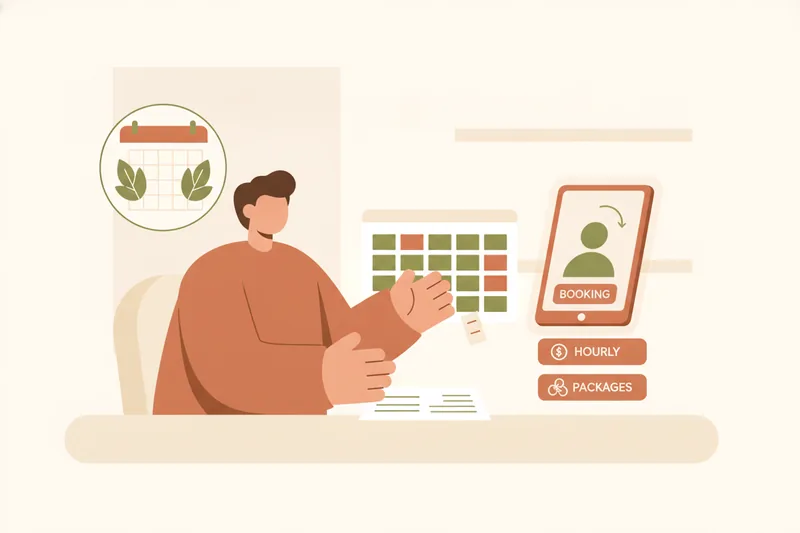
That's when a lesson package or a retainer fits better than a flat hourly rate. A lesson package is a block of lessons sold upfront — say, ten hours — usually at a modest discount versus booking the hours one by one, often with a validity window so the hours don't sit unused indefinitely. A retainer or prepaid arrangement works similarly for ongoing students: they commit to and pay for a recurring block of time each month, which smooths your income and rewards their commitment with a lower effective rate.
The rule of thumb: if you're renegotiating the same hourly number for every booking and cancellations or sporadic scheduling are visibly cutting into your income, stop trying to fix it by raising the hourly rate. Price the commitment instead, through a package or retainer, and keep the hourly rate as your baseline for one-off or trial lessons only.
What Shapes a Tutoring Rate
Subject and grade level
Subject and level are the first filter on any rate. Conversational practice and beginner lessons sit at the lower end of the market because the material is broadly reusable across students. Advanced, academic or certification-linked subjects — business language, technical or legal translation prep, advanced grammar for professional exams — tend to command more, because they demand deeper subject expertise and more bespoke preparation per student. Teaching an advanced learner heading into a professional exam is simply a different job than teaching a beginner their first fifty words, and the rate should reflect that difference in skill and prep time, not just the hour on the clock.
Location and delivery mode
Location still matters, even for a trade that's gone largely online: tutors based in, or serving students in, higher cost-of-living metro areas and international hubs can generally sustain higher rates than those serving smaller regional markets, since local comparables and what students expect to pay both shift with the cost of living. Delivery mode narrows that gap. Online tutoring is often priced a little below in-person lessons, but the gap varies by subject and market, and in some cases it disappears entirely once you account for a tutor's reputation or specialization. Location can also carry a quieter cost: depending on where you're based, even running tutoring as a sole proprietor may require local registration or a license, and that overhead is worth folding into your rate rather than absorbing silently.
Test prep and specialized tutoring
Test prep and other specialized tutoring sit at the premium end of the market, and the spread here is unusually wide. Rates for specialized or exam-prep tutoring commonly start around $50 an hour for less experienced tutors and climb to $200–$400 or more for specialists with strong track records and consistent referrals. The premium is earned, not assumed: it reflects structured lesson planning, familiarity with a specific exam's scoring, and often a visible history of results, not just the subject label.
Experience, materials and demand
Beyond subject and format, three things move you within whatever range applies to you. Experience and credentials are the most obvious — more years teaching, relevant certifications, or specialization in a niche all justify sitting higher in the range. Materials matter too: tutors who build bespoke lesson plans, practice sets or homework for each student are doing work the hourly rate needs to cover, even when it happens outside the lesson itself. And demand is the most direct signal of all — if you're consistently fully booked or running a waitlist, that's the market telling you your current rate is below what it will bear.
A Rule of Thumb for Setting Your Own Rate
Start by finding your actual market band: look at what comparable tutors — same subject, similar level, same delivery mode, similar region or platform — are charging, rather than a generic national average. That gives you a realistic floor and ceiling to work within, not a single number to copy.
Then position yourself inside that band honestly. New tutors with limited track record generally sit near the lower third; tutors with several years of experience, strong results, or a specific credential sit in the middle; tutors with a long waiting list, deep specialization, or a strong referral network can justify the upper third or above it.
From there, adjust for format and specialization rather than guessing. Add a premium — not a markup you invent, but one that matches the extra prep and expertise — for exam prep or other specialized, high-stakes tutoring, since that's consistently the part of the market willing to pay more. For group lessons, set your per-seat rate so that the total across the group clears more per hour than your solo rate would, while each student still pays less than one-to-one. Revisit the position at least once a year: if demand has outpaced your schedule since you last set your rate, that's the signal to move up within the band, not just to hold steady out of habit.
Quick Answers on Tutoring Rates
Is $30 an hour good for tutoring? It depends entirely on what you're comparing it to. For a beginner-level or conversational subject in a lower cost-of-living market, $30 can sit comfortably inside the normal range. For specialized or exam-prep tutoring, $30 sits below the typical range, which commonly starts around $50 an hour for newer tutors and runs up toward $200–$400 or more for experienced specialists, so the same number means something very different depending on subject and experience. It's also worth noting that rates advertised by large managed tutoring services, which match students with tutors and set the price themselves, aren't a reliable benchmark for what an independent tutor should charge — those numbers reflect a different business model, not your market position.
How do I know when to raise my rate? The clearest signal is sustained demand: a waitlist, a fully booked schedule, or students readily accepting a quoted increase. Pair that with an annual review rather than reacting case by case, so your rate keeps up with your experience and demand instead of lagging behind it.