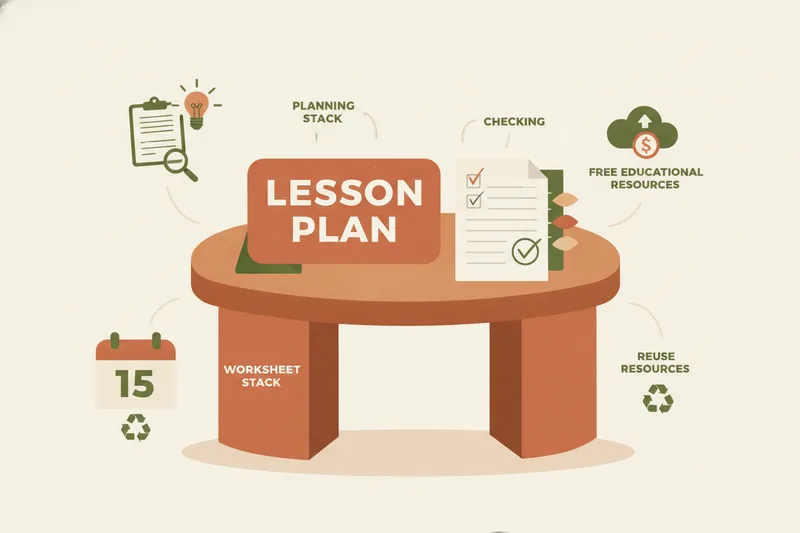
Free Educational Resources for Language Teachers: What's Actually Worth Using
Free educational resources for teachers aren't in short supply — the real question is which free educational resources for teachers are worth a lesson slot. A free educational resource is any teaching material made available without a purchase: a lesson plan, a printable worksheet, a chapter from an open textbook, a recorded webinar, a format someone else built and shared. The categories themselves are well known; what separates a useful one from a time sink is whether it fits the level being taught, holds up to a quick accuracy check, and slots into a lesson that's already planned rather than becoming the plan itself.
What Counts as a Free Educational Resource?
A free educational resource is simply a teaching material a teacher can use at no cost, as opposed to something bought from a marketplace or bundled into a paid course. The category is broad. Lesson plans lay out an objective, the activities that build toward it, and rough timing. Printable worksheets give students practice on one skill — verb conjugation, a reading passage with comprehension questions — usable on paper or on screen. Open textbooks are complete course materials published under a license that allows free use and often free adaptation, unlike a commercial textbook chapter that stays locked to one edition. Webinars for educators are live or recorded sessions, usually run by publishers, universities or teacher associations, that cover a technique or a piece of research rather than supplying a specific lesson. None of these cost money; what varies is how directly usable each one is without extra work from the teacher.
The Main Types of Free Resources Teachers Draw On
Across subjects, free resources tend to fall into a few recognizable kinds, with language teaching adding a handful of its own.
Materials general to any subject
Printable worksheets and practice sheets cover a single skill and can be reused across classes with small edits. Reusable formats — a lesson outline with blanks for the teacher's own content, a grading rubric, a feedback sheet — save planning time without dictating what goes into them. Teacher-created materials, shared through blogs, forums or shared drives, tend to be more classroom-tested than official releases but uneven in quality, since nothing checks them before they're posted. Webinars for educators and recorded professional-development sessions fill in technique and theory between lessons, rather than supplying material for the next one.
Materials specific to language teaching
Language teaching draws on a few resource types other subjects lean on less. Graded readers and short stories, pitched at a stated proficiency level, build reading, listening and pronunciation together rather than any one skill in isolation. Audio and video clips with transcripts serve listening practice specifically. Vocabulary lists and spaced-repetition sets support retention between sessions. Exam-prep instructors additionally draw on past papers and official exam-board sample materials, which track the real test format more closely than a generic worksheet does.
A Free Resource in Practice: One Worked Example
Take a free worksheet on past-simple irregular verbs, the kind widely available from language-teaching blogs and resource sites. On its own, it is a page of fill-in-the-blank sentences and an answer key — nothing more. Used well, it sits inside a lesson that already has a goal: the student has been mixing up irregular past forms in speech, and the teacher sets aside fifteen minutes to drill them before moving to freer conversation practice. The teacher adjusts the sheet to fit the student in front of them — for instance, reusing vocabulary from a text the student is already reading rather than handing over the sheet exactly as downloaded. During the lesson, the worksheet becomes the controlled-practice stage: the student completes it, the teacher checks answers together rather than just handing back a score, and any form still shaky gets flagged for next time. The worksheet did useful work, but the lesson around it — the objective, the adaptation, the follow-up — is what the teacher supplied, not the free file. A resource downloaded cold and run exactly as published rarely fits a specific student as well as one adjusted this way.
Free Resources vs. Paid Materials and Curriculum Frameworks
Free resources aren't the same thing as paid marketplace materials, even when they look alike on the page. A worksheet bought from a teaching marketplace usually comes with more editorial polish — proofread, levelled, sometimes piloted with real classes — and part of the price is payment for that quality control. A free equivalent can be just as good, but nothing stands behind it if it's wrong; checking it falls to the teacher.
Curriculum frameworks are a different thing again: not materials, but the structure a teaching program is built around — the goals or standards that decide what gets taught at each stage. A widely used example in language teaching is the set of five goal areas behind the ACTFL World-Readiness Standards — communication, cultures, connections, comparisons and communities — which describe what a program should develop, not how to run any single lesson. A free worksheet or a paid one can both serve a curriculum framework; neither replaces it. The same distinction applies to the underlying teaching approach a program follows, and the specific classroom techniques used to carry it out: a free resource operates at the technique level, not as a substitute for having an approach. Professional development follows a similar pattern — a single free webinar is one format among several, alongside recorded courses and ongoing peer-learning groups, and it serves a different purpose than a one-off resource does.
How to Judge Whether a Free Resource Is Actually Good
Not every free download earns the slot it takes in a lesson. A few checks separate what's worth keeping from what's worth skipping.
Accuracy comes first: is the grammar explanation actually correct, does the audio transcript match the recording, does the answer key match the questions. Materials written by non-specialists circulate online as readily as expert ones, and a wrong rule taught once takes work to undo later.
Appropriateness for level matters as much as correctness. A worksheet pitched at an upper-intermediate learner will frustrate a beginner even when every sentence on it is grammatically sound; matching vocabulary load and instructions to where the student actually is counts for more than how polished the resource looks.
Source and currency are worth a glance too. A resource from a publisher, a university program or a teacher association has usually had more scrutiny than an anonymous upload, and anything referencing an outdated exam format or a retired course convention needs a second look before use.
Fit with the lesson's actual objective is the last filter. A resource can be accurate, correctly levelled and well sourced, and still be the wrong pick if it doesn't connect to what the student needs that session — a beautifully made grammar worksheet is no help when the goal is conversational fluency.
Where Free Resources Stop Being Enough
A handful of free worksheets and a saved webinar link work fine for a single lesson. They stop working once a teacher is running several students or groups at once. Loose files have no structure connecting them to a specific lesson or student, so after a few months it's unclear which worksheet went with which session, or whether a student already saw it. There's no tracking — no record of what's been covered, what's pending, or what a student struggled with last time, beyond what the teacher remembers. And there's no personalization built in: every adaptation has to be redone by hand each time, because the resource itself doesn't know which student it's for.
This is usually the point where organizing materials over a full term matters more than finding another free file — independent teachers start looking past folders and downloads toward a dedicated system for keeping lessons, students and materials together.