What Counts as Teaching Materials? A Clear Guide for Language Tutors
Teaching materials are the actual content and tools a teacher puts in front of a student to work toward a specific lesson goal — a worksheet, a recording, a set of flashcards, a short reading passage, a grammar handout. They are not the plan for the lesson and not the curriculum behind it; they are what the student sees, hears, and works with in the room. Understanding that distinction, and the handful of categories materials fall into, matters more than collecting another list of resource links.
What Teaching Materials Actually Are
In education, this is often referred to as teaching learning materials, sometimes shortened to TLM: anything a teacher selects or creates to help a learner reach a specific objective, used by both sides of the lesson rather than sitting in a drawer. The word "selects" matters as much as "materials." A grammar PDF saved on a laptop is not yet teaching material — it becomes one the moment a teacher picks it, for this student, to serve this lesson's goal, whether that goal is past-tense practice or airport vocabulary for a trip next month.
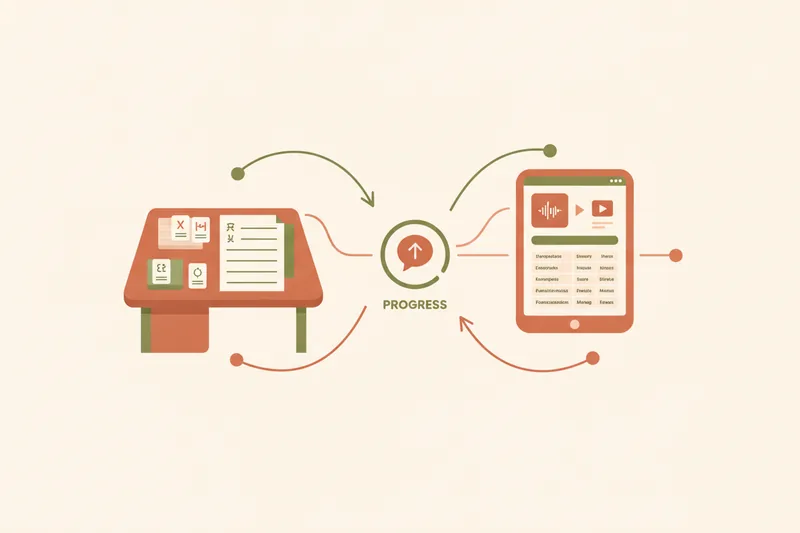
That deliberate selection is also what separates material from clutter. A teacher who has built up years of worksheets, audio clips and slide decks does not have a stack of teaching materials sitting idle — each item only becomes material again when it is matched to a lesson's purpose. A teacher can give a student a plain file — a PDF, a document, a spreadsheet, an image, an audio recording — or a link, and either keep it available to the student at any time or attach it to one particular session. Both are teaching material; what differs is only how and when the student can reach it.
The Main Categories of Teaching Materials
Most language-teaching material falls into a small number of categories, and it helps to think in these rather than by format name.
- Physical supplies: objects used in the room itself — realia, flashcard sets, board markers, printed games, anything tangible a teacher brings to a lesson.
- Printed materials: worksheets, handouts, grammar reference sheets and reading passages produced on paper, whether bought, created, or printed from a digital source.
- Digital resources: anything delivered on screen — audio tracks, video clips, slide decks, interactive exercises, or a simple shared document.
- Open educational resources, usually called OER: materials released under a license that allows teachers to use, adapt, and share them freely, as opposed to material under standard copyright that can only be used as published.
None of these categories is inherently better; a laminated flashcard set and a video clip can serve the same vocabulary goal. The category only tells you how the material is produced and delivered, not whether it belongs in a given lesson — that judgment still comes from the lesson's goal.
What These Materials Look Like in a Language Lesson
In a language classroom, the categories above take familiar shapes. Flashcards and realia cover vocabulary and concrete nouns. Worksheets drill grammar points or guide a reading. Audio and video give learners exposure to pronunciation, intonation and natural speech, and short stories do similar work — building reading, listening and pronunciation together rather than any one skill in isolation.
On the digital side, the same lesson content can take several forms: a plain text passage, an embedded recording, a short video, an image for a picture-description task, or a focused list of target words with their translations and, where useful, an example sentence — a format commonly called a vocabulary list, which is study material rather than a task to be submitted, since it is meant to be referred back to rather than handed in for marking. A lesson built from several of these pieces — a short reading, a related audio clip, a vocabulary list, a follow-up task — is really a stack of individual materials, each chosen to do one specific job inside that lesson.
Materials vs. Curricula, Lesson Plans, and Homework
These terms get used loosely, but they describe different layers of teaching, and keeping them separate avoids a lot of confusion. A curriculum is typically understood as the longer-range map of skills and topics a course covers over weeks or months, generally independent of any single lesson. A lesson plan is the session-level decision of what will happen and in what order — warm-up, presentation, practice, review — a structure, not content. Teaching materials are what fills that structure: the specific worksheet, recording or exercise chosen for step two of today's plan.
Homework sits just outside the lesson itself. One useful way to think about it: a piece of material can have two parts — one the teacher goes through together with the student during the lesson, and one the student completes alone afterward and submits back for review. The first part is teaching material in the lesson sense; the second is homework built from that same material, extending its use beyond the session.
This is also why reusability matters. A worksheet or interactive exercise built once can be used again across different students or repeated lessons rather than rebuilt from scratch each time, and keeping those pieces sorted — even just into simple folders — makes them easier to find without changing how any single one gets used in a lesson.
Digital vs. Physical Materials, and Why Tracking Them Matters
Physical materials still earn their place for anything tactile — flashcards a young learner can hold, a board game for speaking practice, printed pages for a student without reliable screen access. Digital materials cover everything that benefits from being reused, shared instantly, or embedded directly into a lesson: recordings, slide decks, documents, links. Neither format replaces the other; a teacher usually runs both side by side depending on the student and the goal.
What digital materials add is persistence, and that is exactly where many teachers lose things without noticing. A lesson's live chat or shared workspace often exists only for the duration of that session — once it closes, anything typed or dropped into it during the call can disappear with it, so anything worth keeping has to be saved separately, as an actual material, before the room shuts. Over a term, the practical cost of not tracking materials is not losing one file — it is losing the thread of what a given student has already seen, which makes it hard to build each new lesson on the last one instead of repeating ground already covered. Independent teachers working without an institution behind them often solve this with a simple digital system — shared folders, a cloud drive, or a dedicated organizing tool built for teaching — mainly so materials and the lessons they belong to stay connected rather than scattered across devices and chat apps.
Where Materials Alone Stop Being Enough
A folder full of excellent materials does not amount to a lesson. In the older vocabulary of language teaching, there is a useful three-layer distinction: an approach is the underlying theory of language and learning, a method is the overall plan built on it, and a technique is the specific classroom activity that puts it into practice. Materials sit at the technique level — they are the content of an activity, not the reasoning behind why that activity happens now, with this student, in this order.
That is why sequencing matters as much as selection. Grouping related materials into an ordered sequence — a short reading followed by a vocabulary list followed by a speaking task — turns separate resources into something closer to a mini-course a student can move through lesson by lesson, rather than a pile of unconnected files. Tidying that library into folders helps a teacher find things faster, but it is a separate job from deciding which materials belong together in sequence for a given student. A teacher who has the best worksheet in the world but drops it into the wrong point in a lesson, or without the structure to introduce and follow up on it, gets far less out of it than one who has a plainer resource placed with intent. Materials are the ingredients; the lesson's structure and delivery are what turn them into actual teaching.