How to Start a Tutoring Business: Step-by-Step
Learning how to start a tutoring business comes down to five decisions made in order — who you teach, what you plan, how you register, what you charge, and how you get found — followed by an operational layer that most launch guides skip entirely. That layer, setting up reliable scheduling, payment tracking, and materials delivery, is what separates a tutor who picks up occasional word-of-mouth lessons from one running an actual business. This guide walks through the full sequence step by step, including a worked example, so you can see where each piece fits before your first paying student arrives.
What You'll Have Once Your Tutoring Business Is Running
By the end of this sequence you'll have a defined niche and a client base that matches it — not "anyone who wants to learn Spanish," but a specific learner profile you can describe in one sentence. You'll have a pricing structure with published rates and at least one lesson package, basic legal footing appropriate to a solo or small operation, and one marketing channel that's actually producing inquiries rather than sitting idle.
You'll also have an organized scheduling and payment system, which matters more than it sounds like it should. Many tutors report spending a large share of their working hours on preparation and administration rather than actual teaching, so a setup that handles bookings and balances without manual tracking isn't a convenience — it's what keeps the admin load from eating into teaching time. Scheduling and payment-tracking tools built for tutors are generally designed around supporting the tutor's practice rather than the student directly, a reminder that this is infrastructure for running the business, not just a perk for your students.
What to Have Ready Before You Start
Before you touch a business plan or a pricing sheet, four things need to be in place.
Subject expertise or teaching experience: a credential helps, but what actually matters is evidence you can point to — exam results, fluency gains, grades, or testimonials from students you've already taught informally.
Time availability: decide how many teaching hours a week you can realistically commit, and budget admin hours separately — the two draw from the same week but aren't the same task.
Startup budget expectations: most solo tutoring practices start lean, but expect some cost for registration, a basic website, and whatever scheduling or payment tools you adopt.
Awareness that legal requirements vary by location: most businesses, including sole proprietorships, need some form of license or registration even without forming a formal company, but the specifics differ by city, state, and country, so confirm your own requirements locally rather than relying on general advice.
The Step-by-Step Sequence to Launch Your Tutoring Business
-
Define your niche and target student profile. Pick the learners you teach and the outcome you promise them — conversational business French for relocating professionals, or IELTS writing for university applicants — narrow enough that your marketing message writes itself. You now have a one-sentence answer to "who do you teach."
-
Write a one-page business plan. Put your offer, target market, pricing range, and a basic financial goal — such as the number of weekly lesson hours needed to cover your expenses — on a single page. You now have a plan you'll actually re-read instead of one buried in a document you'll never open again.
-
Handle legal and registration basics for your area. If you're operating as a sole proprietorship, registration is usually lighter than forming a company, but either way you'll typically need some license or registration before you can invoice formally. Register your business name and tax status with your local authority. You now have a business recognized well enough to invoice students and, where relevant, deduct expenses.
-
Set your pricing and lesson packages. Based on commonly cited industry ranges, specialized and exam-prep tutoring rates span roughly $50 an hour for newer tutors up to $200–$400+ for specialists with a strong track record and referral base. If you teach online, price toward the lower end or add a discount, since online sessions commonly run 10–25% cheaper than in-person tutoring; if you teach in person, price toward the higher end of your range. Then build at least one multi-lesson package priced at a modest discount to reward commitment. You now have published rates and package tiers a student can act on.
-
Build a simple marketing plan: website, social presence, referrals. A one-page website with your niche, rates, and a way to request a lesson covers most of what you need; add one social channel where your target students spend time, and a simple referral nudge for existing students. If you look at where tutors are typically listed, the common split is between marketplaces, where students browse many tutors, and course platforms, where you sell pre-built content — neither replaces having your own page that sends inquiries straight to you. You now have at least one channel producing inbound inquiries.
-
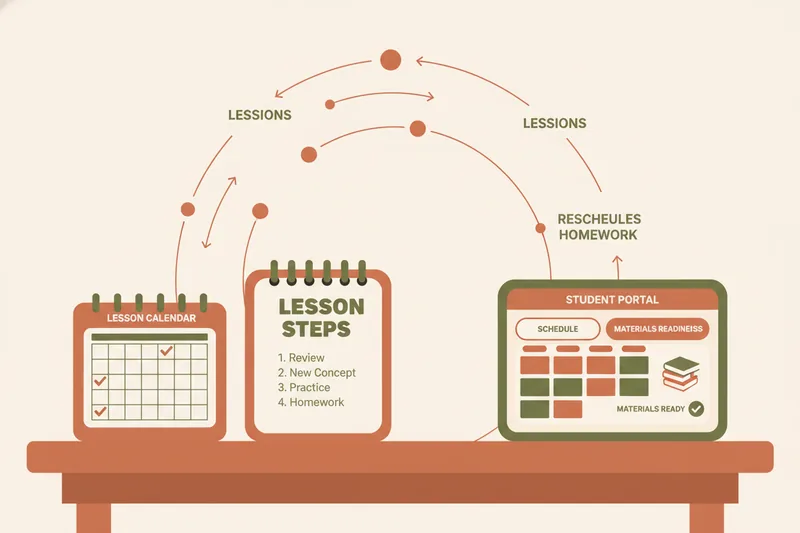
Set up scheduling, rescheduling rules, and lesson logistics. Decide your booking windows — the hours you're actually open to lesson requests — and a clear rule for reschedules, such as a 24-hour notice cutoff. If a student commits to a regular weekly slot, set it up as a repeating series so each lesson stays individually editable; otherwise, book lessons one at a time as requests come in. You now have a repeatable way to book and reschedule lessons without renegotiating each one by message.
-
Set up payment tracking and materials delivery. Decide whether you'll track what students owe in money or as a count of lessons, record payments as they arrive, and attach materials and homework to the specific lesson they belong to rather than a shared folder, ideally somewhere students can see their own schedule, balance, and materials in one place. You now have a system that shows, for any student, what's paid, what's planned, and what's due next — with materials reaching the right person automatically.
-
Run your first worked example: one niche, one price, one booked lesson, one balance update.
Here's how that looks end to end. Say your niche is business English for mid-career professionals preparing for international roles. You set a rate of $45 an hour — toward the lower end of the specialist range, since you're newly independent and teaching online — and offer a 10-lesson package at a 10% discount. A visitor finds your one-page site through a LinkedIn post, requests an intro lesson for Thursday at 6 p.m., and it lands on your calendar without a round of back-and-forth messages. The student pays you directly by bank transfer before the lesson and lets you know; you record that payment against their balance and watch it drop from 10 unpaid lessons to 9. You attach a vocabulary list and a short reading to that Thursday lesson so the student has it in advance. After the lesson, the balance shows one lesson used, nine remaining, and materials delivered — proof the whole sequence, from niche to payment, holds together without a spreadsheet in sight.
How to Tell Your Setup Is Actually Working
A launch sequence is only proven once it holds up under real use for a few weeks. Four signs tell you it's working.
Inquiries arrive steadily, not in one burst after you post something. A single spike from a social post isn't a channel; a trickle of one or two requests a week from the same source, sustained over a month, is.
Bookings confirm without back-and-forth. If a student can see your open times and request one without three messages to agree on a slot, your scheduling setup is doing its job.
Balances stay accurate without you reconstructing them from memory or a chat thread. You should be able to answer "how many lessons does this student have left" in seconds, not by scrolling back through payment messages.
Materials reach students on time, attached to the right lesson, before it starts — not emailed the morning of, or forgotten until the student asks.
If any of these isn't true a month in, the gap usually traces back to one of the setup steps above rather than a new problem.
Common Startup Mistakes and How to Fix Them
Underpricing is the most common mistake, usually from comparing yourself to marketplace rates instead of independent specialist rates. Fix it by moving toward the higher end of your niche's range as referrals and results build, rather than discounting to win the first few students.
No-shows and late cancellations quietly erode income. Set a cancellation cutoff — 24 hours is common — and a rule for after it: the lesson is marked missed and deducted from the student's balance as a burned lesson, rather than silently rebooked. If your packages never expire, consider adding a validity period, since lessons with no expiry make it harder to know what's actually still owed.
Disorganized tracking across spreadsheets and chat threads is a scaling problem more than a day-one one: it's manageable at two students and unworkable at fifteen. Fix it before it breaks, not after.
Inconsistent marketing effort — posting for a week, then stopping — produces the inquiry spikes mentioned above instead of a steady channel. Pick one channel and keep a fixed, modest weekly effort on it rather than switching tactics every month.
Once niche, pricing, legal basics, and marketing are in place, the scheduling-and-payment layer is what keeps the business from reverting to spreadsheets and scattered chats as you take on more students. It's worth looking into dedicated scheduling-and-lesson-management tools built specifically for tutors — platforms like Umvelo handle bookings, reschedules, package balances, and materials delivery through a student portal, while payment itself stays directly between you and your student.