Best Online Tutoring Platforms for Tutors 2026
"Best online tutoring platforms for tutors" lists almost always mean best platform for finding new students — and that answer looks different once you already have a roster to teach, bill, and send homework to. For a tutor running an existing practice, the useful comparison splits by job: platforms built for student acquisition, which take a cut for the traffic they bring, versus all-in-one practice-management tools built for scheduling, payment-ledger tracking, and materials delivery. This guide ranks options against that distinction, not against marketplace reach.
Marketplace Apps vs. All-in-One Practice Management Tools
A tutoring marketplace — Wyzant, Preply, Tutorful — exists to put a tutor's profile in front of students who are searching for one. You pay for that reach, usually through a percentage taken from every lesson payment or a listing fee, and in exchange the platform handles discovery, matching, and often the first message that turns into a booking.
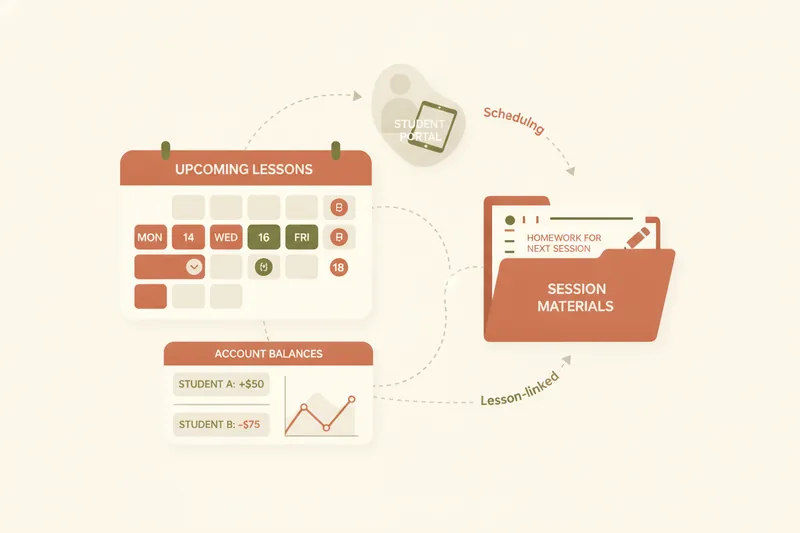
A practice-management tool solves a different problem: you already have the students, and you need one place to run the lessons — a calendar that handles reschedules without a text-message back-and-forth, a ledger that shows what's paid, planned, and available per student, and a way to hand over materials and homework tied to the lesson they belong to, usually through a student-facing portal rather than email attachments.
The two categories aren't competing for the same job. A tutor with open hours on the calendar needs a marketplace; a tutor with a dozen regular students and a spreadsheet of balances needs a practice-management tool. Some tools in this category even include a sandbox lesson you can build and test before any real student sees it.
Quick Picks: Best Platform for Each Tutoring Need
- Wyzant — best for finding new students. It's the largest marketplace by search volume and listing traffic, which matters if your calendar has hours to fill.
- Preply — best for bundling discovery with delivery. It pairs student matching with built-in video lessons, useful for a language tutor who wants acquisition and the lesson room in one place, in exchange for a commission on lessons.
- Varsity Tutors — best for exam-prep visibility. It carries strong brand recognition in the test-prep niche and presents itself as a managed service that assigns students rather than an open marketplace where tutors bid for them, which matters in a niche where specialist rates can run from around $50 an hour to $200–$400 or more for tutors with strong track records.
- A practice-management workspace built for tutors with existing students — best for commission-free ledger tracking, scheduling, and materials. These tools run on a ledger-only model, with no cut taken from what a student pays you directly, and they centralize the admin load in one record. That matters because independent tutors typically spend more of their working hours on prep and administration than on teaching itself, and a scattered setup is where that time leaks.
- A calendar app plus a spreadsheet — best for a very small, solo practice. It costs nothing beyond the calendar's free tier, and for two or three regular students manual reconciliation still holds up — until reschedules and package balances multiply.
How We Evaluated These Platforms
We judged every option, marketplace or practice-management tool, against five criteria that matter once you have students to run lessons for, not find:
- Scheduling and rescheduling: can a student request a new time without a direct message, and does the calendar stay in sync for both sides?
- Payment-ledger tracking: does the platform show what's paid, what's planned, and what's left in a package, without taking a percentage of the payment itself?
- Materials and homework delivery: can a file or link attach to a specific lesson so the right student sees the right material, instead of hunting through email?
- Student self-service portal: does the student have their own view of schedule, balance, and materials, or does every question still route through the tutor?
- Fees and commissions: what does the platform cost — a percentage of lesson revenue, a flat subscription, or nothing beyond what a payment processor already charges?
We didn't test teaching quality or outcomes; that's a separate question from whether the software gets out of a tutor's way. Where a platform lets a tutor publish a public page to attract students, we also checked whether those pages are reviewed before they go live, since a moderated page protects both the student and the tutor's reputation from misleading listings.
Side-by-Side: Scheduling, Payments, and Materials
Scheduling flexibility differs most between categories. Marketplaces like Wyzant and Preply build calendars around new-student discovery, and reschedules for existing students often still happen by message. Dedicated scheduling tools handle this more directly, with features built around recurring bookings and package-based sessions — closer to how a tutor with returning students actually sells lessons.
Payment and ledger visibility is where the categories diverge most sharply. A marketplace shows what it paid out after its cut; a practice-management tool shows the ledger itself, sometimes letting a tutor choose how balances are tracked — in money, in a count of lessons, or per student — so a reported payment maps cleanly to lessons used.
Materials delivery and student portals are improving across both categories but remain uneven. Music Teacher's Helper, for example, gives students a login to view assignments and log practice time, not just a billing page — a sign that materials and a self-service portal are now expected together rather than bolted on separately. For group lessons specifically, the stronger tools track one shared schedule and shared materials while still charging each participant from their own balance per session.
How Commissions and Fees Differ
Commissions are the clearest dividing line between the two categories. Marketplaces fund their acquisition machine by taking a percentage of every lesson payment — the cost of the leads they generate, reasonable when you need new students, a direct cost when you don't. That cut compounds against rates that already vary widely: specialist and exam-prep tutors can charge a wide range depending on experience and reputation, with rates rising substantially for tutors with a strong track record and referral-driven practice, so a percentage taken on the higher end of that range is a meaningful sum to give up on a student you found yourself.
A no-commission, ledger-only model works differently: the platform never touches the payment, so there's nothing to take a cut of. It tracks what a student reports paying and what that buys in lessons, in the same spirit as tools that charge no transaction fee or commission beyond whatever the payment processor itself costs. The trade-off is that the tutor, not the platform, confirms a payment actually happened — a receipt attached and checked, rather than a transaction the platform processed.
For a tutor who already has students, the commission question usually settles the category choice on its own: a flat subscription for administration is a predictable cost; a commission on lessons you didn't need help finding is not.
Which Platform Suits Your Situation
A solo tutor with a handful of regular students can run on a calendar and a spreadsheet at first, but it starts costing more time than it saves once package balances and reschedules multiply. A tool that lets you try the full workflow on a sample student before committing real ones is a low-risk way to check whether it actually replaces the spreadsheet.
A small-group teacher deals with a layer spreadsheets handle badly: one shared schedule and set of materials, but individual balances and attendance per participant. Look for a tool that shows a group's members, their balances, and totals like lessons held and average attendance in one view, and that flags payment claims and reschedule requests directly rather than leaving them in a chat thread.
Umvelo, for example, builds that per-student and per-group view directly into its ledger, so a teacher running several small-group cohorts can see each participant's balance and attendance in one record instead of cross-checking a spreadsheet against a chat thread.
An exam-prep instructor needs structured, multi-lesson plans more than general conversation tutoring does, and parents often want visibility into progress, not just the next booking. Varsity Tutors carries recognition specifically in this niche if finding exam-prep students is still part of the job; if the students are already yours, the priority shifts to a tool that holds a lesson plan as an ordered sequence and surfaces which sessions still need marking.
None of these situations are fixed — a solo tutor can outgrow the spreadsheet in a term, and a marketplace tutor can build enough of a base to stop needing the marketplace's reach.
Limits of Each Option
Marketplaces are built to keep matching tutors with new students, which is exactly the feature an existing-student tutor doesn't need and still pays for through commission; most also offer limited ledger detail, since payment routes through the platform rather than a record the tutor controls.
Practice-management tools have the opposite limit: they don't bring you students. An open calendar stays open until a marketplace, a referral, or your own marketing fills it — no ledger or materials feature does that job. Pricing in this category also varies by what's metered; some tools charge by the number of tutors or staff on the account rather than by student count, worth checking before you bring on an assistant.
This comparison has its own limits, too. We evaluated administrative fit, not teaching outcomes, lesson quality, or how a given provider's support handles an edge case — those vary and change over time, and a platform's feature set on the day you read this may differ from the day it was checked here.
Frequently Asked Questions
Can I switch from a marketplace to a practice-management tool without losing my students? Yes — the switch moves the administration, not the relationship. Students already booking directly with you can move to a new schedule and ledger; what you lose is the marketplace's referral pipeline, not the students you already teach.
Does an all-in-one tool end up costing more than a marketplace's commission? Usually not once you have enough regular students. A flat subscription stays level as you teach more, while a percentage commission grows with every lesson — the break-even point depends on your rate and volume, but it tends to arrive faster than tutors expect.
If your actual bottleneck is scheduling, commission-free balance tracking, and lesson-linked materials rather than finding more students, that's the category worth shopping in — a practice-management workspace built specifically for tutors who already have a roster, such as Umvelo, rather than a marketplace built to bring you one.