Language Tutor Hourly Rate: What to Charge
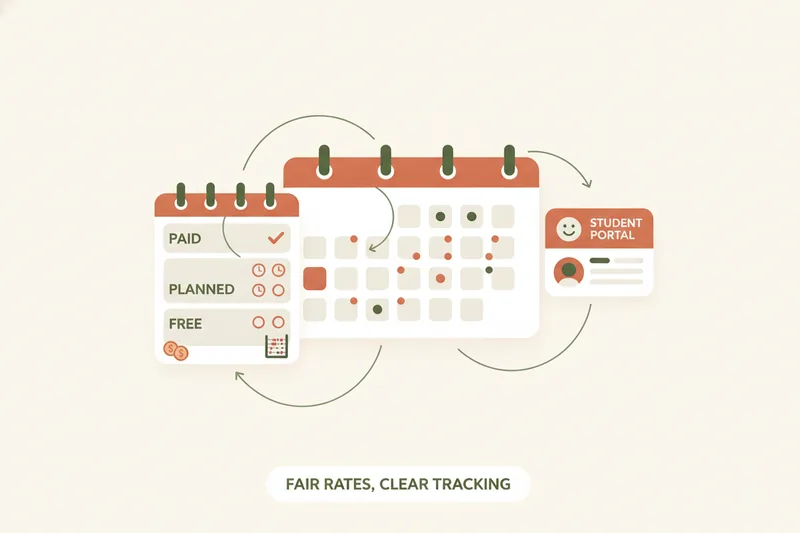
Most language tutors land somewhere between $20 and $45 an hour once you account for experience, format, and how they get paid — but that range only holds up if the underlying rate structure does too. A tutor charging $35/hour on a marketplace that takes a 15-20% cut is effectively earning less than a tutor charging $28/hour and getting paid directly. This guide breaks down the variables that actually set a defensible rate, then shows how packages, reschedule policy, and payment tracking protect that rate once real bookings start.
How Much Does a Language Tutor Cost Per Hour? Quick Answer and What Drives It
A language tutor's hourly rate typically covers five things: their own preparation and grading time, the platform or marketplace fee (if any), the risk of no-shows and last-minute cancellations, their specialization or certification, and the local cost of living where they teach. No single number is "correct" — the rate has to hold up once all five are subtracted from it.
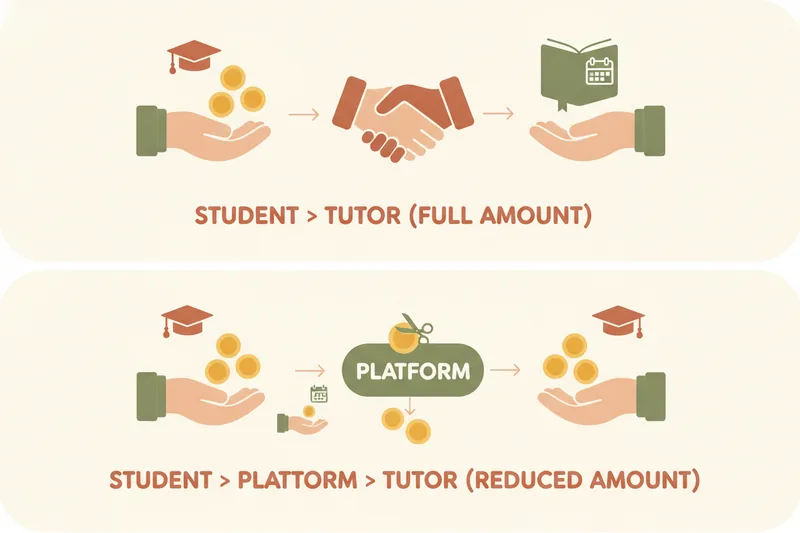
Two payment structures change the math immediately. Direct payment means the student pays the tutor without an intermediary taking a cut, so the quoted rate is the take-home rate. Marketplace commission means a platform takes a percentage before the tutor sees the money, so a $30/hour listed rate might net $24-25/hour in practice. Neither is wrong, but a tutor comparing their rate to a marketplace listing needs to know which one they're looking at.
Quick Rate Table by Experience and Format
| Experience Level | Online Rate | In-Person Rate |
|---|---|---|
| Entry-level / new tutor | $12–$20/hr | $18–$28/hr |
| Intermediate (2–5 years) | $20–$35/hr | $28–$45/hr |
| Expert / certified / native-speaker specialist | $35–$60+/hr | $45–$75+/hr |
These are starting anchors, not a ceiling — language demand, specialization, and region shift them in both directions, covered below.
Average Rates by Experience Level: Entry, Intermediate, and Expert Tutors
Experience is the first variable most tutors price against, and it's worth pinning down before layering anything else on top.
Entry-level tutors — those in their first one to two years, often still building a client base or teaching alongside formal study — generally charge $12-$20/hour online. They're pricing for volume and reviews more than margin at this stage.
Intermediate tutors, with two to five years of consistent teaching and a track record of retained students, typically move into $20-$35/hour. This is the range where most working tutors settle once they've stopped undercharging out of uncertainty.
Expert and native-speaker specialist tutors — certified instructors, those with advanced degrees in linguistics or education, or tutors with a strong niche (exam prep, business language, heritage speakers) — commonly charge $35-$60/hour and above. A recognized certification (CELTA, DELE examiner status, DALF/DELF training, TEFL/TESOL with specialization) is one of the few credentials that reliably lets a tutor charge above the intermediate band without needing years of tenure to justify it.
Online vs In-Person Tutoring Rates
Format is the second lever, and it moves rates independently of experience. In-person tutoring commands a premium — online sessions typically cost 10-25% less than in-person tutoring across experience levels — because in-person work carries travel time, fuel or transit cost, and a smaller addressable pool of students within reasonable distance.
Online tutoring, by contrast, has near-zero marginal travel cost and a global student pool, which is why online rates trend lower per hour but often produce more billable hours per week. The overhead differs too: in-person tutors may need a dedicated teaching space or printed materials, while online tutors need a stable video setup and a way to share materials and homework digitally.
It's also worth separating the tools tutors use online from the marketplaces they sell through. Online tutoring platforms are commonly divided into two categories — tutor marketplaces where students find and book tutors, and online course platforms where tutors build and sell structured courses independent of a marketplace. Rate comparisons that only look at marketplace listings are really comparing marketplace pricing, not the full range of what independent online tutors charge when working off a private client base.
Hourly Rates by Language: Spanish, French, English, and More
Language demand shifts the baseline range on top of experience and format. As a rough guide:
- Spanish: high supply of tutors, especially online, keeps rates on the lower-to-middle end — often $15-$30/hour for conversational or general instruction, higher for exam prep or business Spanish.
- French: moderate supply with steady demand from students preparing for DELF/DALF or academic requirements pushes rates slightly higher, commonly $18-$35/hour.
- English: enormous global demand (business English, exam prep, general fluency) means rates span the widest range, from $15/hour for conversation practice to $50+/hour for certified exam-prep or business-English specialists.
- Less commonly taught languages (Mandarin, Arabic, Japanese, Korean, and smaller European languages) often command a premium of $5-$15/hour above comparable Spanish or French rates simply because fewer qualified tutors are available.
Demand-driven pricing means a tutor teaching a less common language with average experience can often out-earn a highly experienced tutor in an oversupplied language.
Regional Cost Variation and Marketplace Fees (Upwork, Italki, TutorOcean)
Where a tutor is based — and where their students are based — moves the rate further. Tutors located in or pricing for North America, Western Europe, or Australia typically charge toward the higher end of every range above; tutors based in regions with a lower cost of living can charge less and still earn a strong local income, though many now price closer to their students' market when teaching online across borders.
Marketplace commission is the variable tutors most often underestimate. Platforms like Upwork, Italki, and TutorOcean connect tutors with students but take a cut of each payment — commonly in the 15-25% range depending on the platform and lesson volume. A tutor listing $30/hour on a marketplace with a 20% commission is really earning $24/hour. That's not a reason to avoid marketplaces entirely — they solve the discovery problem for new tutors — but it means the "market rate" visible on these platforms understates what a tutor needs to charge to net the same income through direct, no-commission payment. Many tutors use a marketplace to find their first students, then move established relationships to direct payment once trust is built.
What Factors Justify a Higher Rate? Specialization, Exam Prep, and Track Record
Beyond experience, format, language, and region, a handful of qualitative factors let a tutor charge meaningfully above baseline.
Exam-prep specialization is the clearest premium category. Tutors preparing students for IELTS, TOEFL, or Cambridge exams (FCE, CAE, CPE) typically charge 20-50% above general conversation or grammar tutoring, because the work requires structured lesson plans tied to specific scoring criteria, timed practice, and measurable progress tracking that parents and students expect to see.
Specialization more broadly — business language, medical or legal terminology, translation-adjacent work, or heritage-language instruction for children — also supports a higher rate, since it narrows the pool of tutors who can credibly teach it.
Track record matters more than credentials once a tutor has one: documented student outcomes (exam scores achieved, fluency milestones reached) let a tutor charge a premium that's hard to argue with. And straightforward demand — a fully booked schedule with a waitlist — is itself a legitimate reason to raise rates for new students, independent of any other factor.
How to Decide What to Charge as a Tutor
A workable decision framework runs in this order:
- Start from experience tier (entry/intermediate/expert) to set a baseline range.
- Adjust for format — add 20-40% if teaching in-person.
- Adjust for language demand — check whether your language sits above or below average supply.
- Adjust for your region and your students' region, especially for cost of living if teaching locally versus internationally.
- Add a specialization premium if you teach exam prep or a technical niche.
- Decide your payment model. If you'll take marketplace bookings, price to net your target rate after commission; if paid directly, price at the net rate itself.
- Position against marketplace listings in your language and format, then set your number 10-20% below the top of that range until you have reviews or a track record to justify matching it.
Your target student profile matters as much as the math: a rate aimed at busy professionals paying for convenience differs from one aimed at students on a tight budget, even for the same language and format.
Pricing Lesson Packages and Bundles Instead of Single Hours
Most working tutors don't sell single hours — they sell packages: five, ten, or twenty lessons purchased upfront, often at a per-hour discount of 5-15% off the single-session rate. Packages reduce no-shows (students have already committed money) and smooth out a tutor's income.
But a package discount only works if the tutor can see, at any moment, what's actually been used. That's where a simple ledger — a running record of paid, planned, and free lessons — matters more than the headline rate. If a student buys a 10-lesson package and the tutor loses track of how many are left, they either undercharge (giving away lessons) or create friction (disputing a balance). The effective hourly rate after discounts is only the rate you think it is if paid, planned, and free lessons are tracked accurately as they happen, not reconstructed from memory or a chat thread at the end of the month.
Protecting Your Effective Hourly Rate: Scheduling, Reschedules, and Getting Paid
Rate erosion rarely comes from setting the wrong number — it comes from what happens after the number is set: a student reschedules three times and the tutor loses track of what's owed; a payment gets mentioned in chat but never confirmed; a no-show goes untracked and the lesson is quietly written off.
A clear reschedule policy — how much notice is needed, whether a late reschedule counts against the package — only works if it's enforced consistently, which is hard to do from memory across a dozen students. No-show protection means the lesson still counts against the balance unless the tutor explicitly marks it free. And receipts and payment confirmation close the loop: a student marks a payment made and attaches proof, the tutor confirms it, and the balance updates — no guessing whether the last package was actually paid.
This is the operational layer most rate-setting advice skips entirely, and it's exactly where Umvelo fits: it's a workspace built for language teachers that keeps scheduling, reschedules, lesson packages, and the paid/planned/free ledger in one place, with a student portal so bookings and balances stay visible to both sides. It doesn't process payments — students still pay the tutor directly, with no commission taken — it just tracks the ledger and receipts so the rate a tutor set on paper is the rate they actually collect.
FAQ: Is $30 an Hour Good for a Language Tutor? Is $50 Too Much?
Is $30/hour good for a tutor? For an intermediate online tutor teaching a moderately in-demand language like Spanish or French, $30/hour sits comfortably within the expected range, especially if paid directly rather than through a marketplace that would reduce the net take-home.
Is $50/hour too much? Not for an expert or certified tutor teaching in-person, specializing in exam prep, or teaching a less commonly available language — all three factors independently support rates at or above $50/hour. It would be high for an entry-level tutor teaching general conversation in an oversupplied language with no specialization.
When is a rate justified? When it reflects the actual combination of experience, format, language demand, region, and specialization covered above — not a number picked to match a competitor's listing without accounting for whether that competitor is paying marketplace commission or working direct.
Request access to Umvelo to keep your rates, packages, balances, and receipts in one calm workspace instead of spreadsheets and chat threads.