Online Tutoring for Teachers: Run Your Own Practice

Most searches for "online tutoring for teachers" assume you're looking to get hired — matched with students through a marketplace, paid a per-lesson rate, and handed a account you don't fully control. This guide is for the opposite situation: you already teach, you already have (or are building) your own student base, and you need a way to run scheduling, lesson packages, materials, and student sign-ins as a professional practice — without a platform taking a cut of every lesson.
What "Online Tutoring for Teachers" Actually Means: Marketplace vs. Independent Practice
An online tutoring platform can mean two very different things depending on who's paying whom. Some platforms exist to connect you with students you don't yet have. Others exist to help you run the practice you already have. Confusing the two leads teachers to sign up for the wrong kind of tool.
Marketplace tutoring: get matched, pay a commission
A tutor marketplace lists private tutoring jobs or open student requests, matches you to learners, and typically takes a commission on every paid session — often 15–40% depending on the platform. You don't own the student relationship; if the student leaves the marketplace, they usually leave you too. This model suits teachers starting from zero who need lead generation more than they need practice-management tools, whether they teach 1-to-1 tutoring, group classes, or test prep / exam tutoring for standardized exams.
Independent tutoring: keep your students, keep your rate
If you already have students — from referrals, your own virtual/remote tutoring reputation, or years of in-person teaching moved online — a marketplace adds a middleman you don't need. What you need instead is software that handles the operational side: booking, rescheduling, tracking who's paid for what, and sending materials — while you keep 100% of your rate and the direct relationship with your students. This is the gap tools like Umvelo are built for: a workspace where the teacher, not a marketplace, owns the schedule and the student contact.
The Core Components of Running Tutoring Online
Whether you teach one student or forty, running an independent practice online comes down to four operational pieces. Get these right and the spreadsheets and scattered chat threads disappear.
Scheduling and reschedules that stay in sync
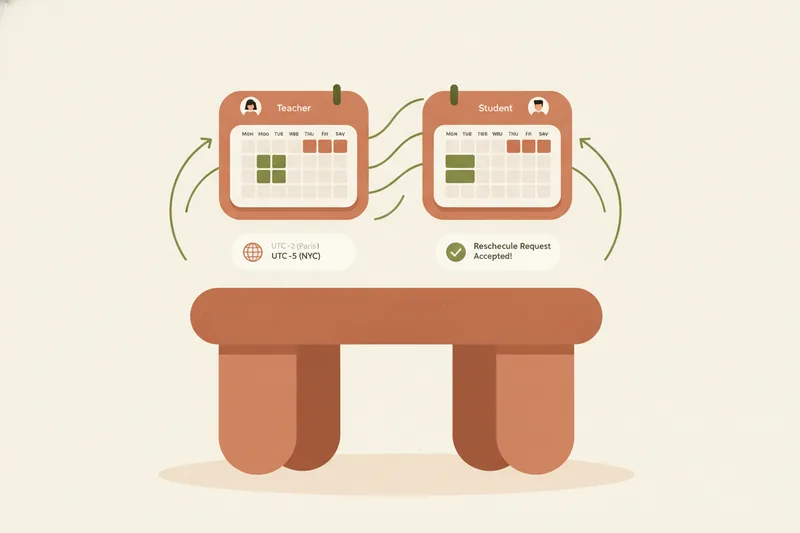
Scheduling software for tutors needs to do more than show a calendar. Students reschedule constantly — a sick day, a work meeting, a time-zone mix-up — and each change has to update both sides at once, not live in a text message you have to remember to reflect in your own calendar. A proper system lets a student submit a reschedule request from their own view and lets you accept it with one action, keeping both calendars honest.
Tracking lesson packages and payment balances
Most independent tutors sell lesson packages — ten sessions prepaid, a monthly block, or pay-as-you-go — rather than billing per lesson. That means someone has to track what's paid, what's been used, and what's left. Without a system, this lives in a notebook or a mental tally that's easy to lose track of once you have more than a handful of students.
Attaching materials and homework to each lesson
Homework and materials scattered across email, Google Drive links, and chat messages force students to hunt for the right file before every lesson. Lesson-linked materials and homework — files and links attached directly to the specific session they belong to — remove that friction, and a student portal gives each learner one place to see their schedule, their balance, their materials, and their grades, instead of five.
Best Online Tutoring Platforms for Teachers: Marketplaces vs. Practice-Management Tools
Some industry write-ups split online tutoring platforms into marketplaces and online course platforms built for selling pre-recorded content. That's a useful distinction if you're deciding between live teaching and course sales — but it doesn't address the question independent tutors actually face, which is about relationship and cost: does the platform own your students and take a cut, or does it just help you run the practice you already own?
When a marketplace makes sense
If you're new to tutoring, have no student base, and need online tutoring jobs by platform to get your first bookings, a marketplace's built-in demand is worth the commission — at least until you've built a referral base of your own.
When independent practice tools make sense
Once you have your own students — from any subject, including common K-12 tutoring subjects or adult language learning — a practice-management tool pays for itself by removing commission entirely. A no-commission ledger simply records what was charged, paid, and is still available, without processing the transaction itself; students still pay you directly.
Free vs. paid: what changes as you grow
Free tools (a shared spreadsheet, a booking link, a messaging app) work for one or two students. As your roster grows, the manual reconciliation — matching payments to lessons, remembering who owes what — becomes the actual bottleneck, which is where paid, purpose-built tools start saving more time than they cost.
A Website for Tutors With Sign-In and Requests
New students need somewhere to find you that isn't a marketplace listing. A personal mini-site on a subdomain — for example, you.umvelo.com — acts as that front door: a page built from ready-made blocks describing what you teach, your rates, and your availability, with sign-in for students and request submission built in, so a prospective student can leave a booking request without you exchanging a dozen emails first.
This matters for new student inquiries specifically: a marketplace profile competes with hundreds of other tutors on the same page; your own mini-site is yours alone, and every request that comes through it is a direct relationship from day one — no commission attached, no platform in between.
How Much Can Teachers Earn Tutoring Online (and What It Costs)
Tutor pay and rates vary widely by subject, language, exam specialization, and market — there's no single industry number worth quoting here, and any site claiming an exact average is guessing. What's consistent is the structural difference: on a marketplace, your effective rate is your listed price minus commission; as an independent tutor, the amount a student pays is the amount you keep.
The question of how much do online tutors cost is really a question your students ask you directly, since you set the rate — not a platform algorithm. Practice-management tools charge a subscription for the workspace itself, not a percentage of your lessons, which is the core of commission-free direct payment: the student pays you, by whatever method you've agreed on, and the platform's job is ledger tracking without holding money — recording what's paid, planned, and remaining, and storing receipts, without ever touching the transaction.
Requirements to Start Tutoring Online as an Independent Teacher
Requirements to start tutoring online as an independent teacher are lighter than marketplace onboarding, but not nonexistent. There's no universal tutor certification requirements list the way there is for classroom teaching — requirements depend on your subject, your country, and whether you're preparing students for a specific exam board. Most independent tutors rely on demonstrable experience, references, or a teaching credential relevant to their subject rather than a platform's internal vetting.
How to become an online tutor independently is mostly a setup question: a way to be found (your mini-site or referrals), a way to schedule and get paid, and a way to deliver materials. On Umvelo specifically, access isn't self-serve — teachers request access and are onboarded by a manager, who sets up the workspace rather than leaving you to configure it alone. Once set up, a connected Telegram bot for student interaction lets students check their schedule, materials, and balance, and send requests, directly inside Telegram instead of a separate app they have to remember to open.
FAQ: Online Tutoring for Teachers
What's the best online tutoring platform for teachers? It depends on whether you're acquiring students or already have them. If you need leads, a marketplace's built-in demand is worth its commission short-term. If you already have your own students, a no-commission practice-management workspace like Umvelo — covering scheduling, lesson packages, materials, and a student portal — keeps more of your rate over time.
Does this work for exam prep / test prep tutoring? Yes — structured lesson plans and materials attached to specific sessions work well for exam-prep sequences, since students and (where relevant) parents can see progress and homework without a separate tracking spreadsheet.
Can I run small groups, not just 1-to-1? Group teaching works the same way as one-to-one: each session on the schedule, materials attached to that session, and each student in the group has their own portal view of balance and grades.
What if I don't want to track money at all? Umvelo supports a lessons only mode where no amounts are tracked — useful if you invoice separately or simply prefer to manage payment outside the platform entirely.
If you're ready to stop reconciling payments in a spreadsheet and chasing reschedules over chat, request access to Umvelo and set up your own scheduling, lesson packages, and sign-in site for students in one calm workspace.