My Teaching Strategies: Framework for Language Tutors
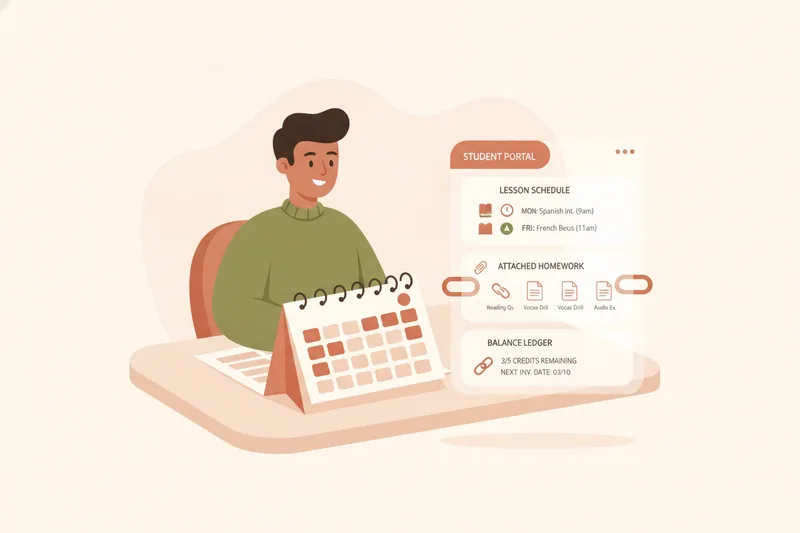
Search "my teaching strategies" and you'll mostly find childcare-center software promising curriculum templates for preschools. That's not what a language tutor needs. Your teaching strategy is the specific combination of how you teach — your pedagogical approach to grammar, conversation, exam technique — and how you run it week after week: the scheduling, materials, and progress-tracking that make that approach show up consistently for every student, not just the ones you remember to follow up with.
What "My Teaching Strategies" Really Means for a Language Tutor
A teaching strategy, for an independent language tutor, is not a single technique like spaced repetition or the communicative method. It's the pairing of your pedagogy — the methods you choose for grammar, speaking practice, or exam skills — with the operational habits that deliver that pedagogy reliably: how lessons get booked, how homework reaches the right student, how you track what's been paid and what's still owed.
This is a useful distinction because most tutoring software doesn't address it directly. The tutoring-software landscape is usually split into tutor marketplaces (where students find and pay you) and online course platforms (for pre-recorded content) — neither is built around running your own recurring, personalized lessons. Even adjacent trades have noticed the gap: music-lesson software now commonly bundles a student-facing portal for assignments and practice logs, because a portal alone doesn't define a teaching strategy — it just supports one.
Whether you teach online or in person — and online sessions typically run 10–25% cheaper than in-person tutoring across experience levels — the underlying problem is identical: pedagogy without operations drifts. A syllabus in your head becomes inconsistent the moment three students reschedule in one week. This is where a workspace like Umvelo fits: it doesn't replace your teaching method, it's the operational layer — scheduling, ledger, materials — that keeps whatever method you've chosen consistent across every student, every week.
The Core Pillars of an Effective Language Teaching Strategy
Strip away the specifics of level, age group, or exam focus, and every workable strategy rests on the same four pillars.
Scheduling as the backbone of any strategy
If lesson times shift unpredictably, everything downstream — pacing, homework, exam countdowns — shifts with them. Consistent scheduling isn't a preference; it's the precondition for the rest of your strategy to function at all.
Homework and materials as the feedback loop
A strategy only works if what you assign is what the student actually does. Materials and homework tied to a specific lesson — not a shared folder or a scrolled-back chat — close the loop between what you taught and what gets practiced.
Tracking progress and balances without spreadsheets
Two kinds of tracking matter equally: what a student has learned (progress, grades) and what they've paid for (their lesson package balance). Spreadsheets can technically hold both, but they don't alert you when a package runs low or a student misses feedback on their last submission — clear communication with students depends on that visibility being automatic, not remembered.
Adapting Your Strategy to Different Teaching Contexts
The four pillars stay fixed; how you apply them changes with who you're teaching.
One-to-one lessons
Here the strategy is personal and reactive: pacing adjusts lesson by lesson, homework is tailored to one learner's gaps, and the ledger tracks a single running balance. Consistency matters most in continuity — picking up exactly where the last lesson left off.
Small groups
With small group teaching, the same lesson serves several students at different speeds. Materials need to be assigned once but remain individually trackable, since not every student in a group is on the same package or paying the same balance. Scheduling has to hold for the whole group, which makes reschedule requests more disruptive than in one-to-one work.
Exam preparation
IELTS, TOEFL, and Cambridge instruction runs on structured lesson plans mapped against a fixed test date, where skipped or reordered sessions have a real cost. Progress visibility matters more here than anywhere else — students, and often parents, want evidence of movement toward a target band or grade, not just a sense that lessons are happening.
Turning Strategy into a Repeatable Weekly Workflow
Principles only matter if they survive a normal week of cancellations and last-minute requests. Here's what that looks like operationally.
Plan and reschedule without back-and-forth
Lessons go on a calendar once; reschedule requests come in through the student portal and get accepted or declined without a chat thread negotiation, with both calendars staying in sync automatically.
Attach the right materials to the right lesson
Files and links get attached directly to the lesson they belong to, visible only to the students they're intended for — so "did you send me the worksheet?" stops being a recurring message.
Keep balances and receipts current
When a student pays you directly, they mark the payment and attach a receipt; you confirm it, and the lesson package balance updates to reflect what's paid, what's planned, and what's left. A Telegram bot integration lets students check that balance, book a lesson, or send a request without opening a separate app — useful if most of your student communication already happens in Telegram.
Choosing a System That Supports Your Strategy (Instead of Working Against It)
When evaluating any tool against your strategy, ask whether it holds scheduling, materials, and your ledger in one place, or whether you'll still be reconciling three tools by hand. Umvelo was built around that single-place principle: lessons, homework, and lesson package balances live against the same student and lesson record, with no commission taken on payments — students pay you directly, and the platform only tracks the ledger of what's paid, planned, or free.
Beyond the core workflow, two features extend the strategy outward and inward. A personal mini-site on a subdomain lets you publish your offer and take student requests without building a website from scratch — useful for the "how do students find me" half of running a tutoring practice. An in-lesson builder with a whiteboard lets you run a lesson from prepared blocks while watching student answers live, keeping the pedagogy and the operational record in the same place instead of split across a video call and a notebook.
Because Umvelo is onboarded rather than self-serve, access starts with a request, and a manager sets your account up with you — useful if you'd rather start with your workflow mapped out than figure out the settings alone.
FAQ: Building and Running Your Own Teaching Strategy
How do I start defining a teaching strategy? Start from your pedagogy — the method you already use for grammar, speaking, or exam skills — then write down the operational habit that should support it every week: how lessons get scheduled, how materials get delivered, how balances get tracked.
How do I keep lesson plans and homework organized? Attach materials to the specific lesson they belong to rather than a shared folder, so each student's portal only shows what applies to them.
How do I track what students owe without handling their money? Use a ledger that records paid, planned, and free lessons based on receipts the student submits and you confirm — the platform tracks the balance; you and the student handle the payment directly.
How do students book or reschedule? Through their own student portal or a connected Telegram bot, where requests sync back to your calendar instead of arriving as separate messages.
Your teaching strategy is worth as much as the system that runs it week to week. See how Umvelo turns your teaching strategy into a working system — request access and get onboarded by a manager.