Professional Development for Teachers: Definition & Options
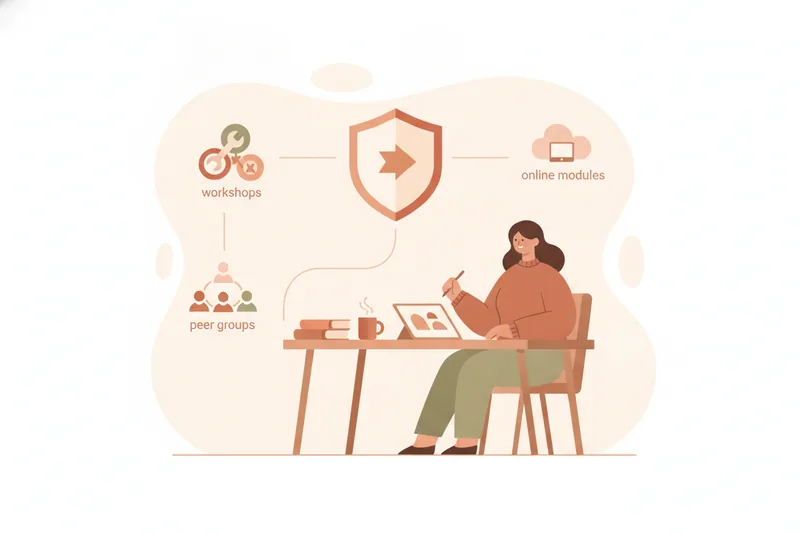
Professional development for teachers means any structured activity that builds your teaching knowledge or skills beyond your initial training — a workshop, a certificate course, a peer study group, or a stretch of time spent reading research and testing it in your own classroom. For school-employed teachers it often arrives as a requirement tied to license renewal; for independent tutors and exam-prep specialists, it's something you build yourself, without an institution setting the calendar or paying the fee. The options span free webinars, paid certificates, continuing education credits, and informal peer communities, and the right mix depends on your role, your subject, and how much outside structure you actually need.
What Counts as Professional Development for Teachers
Professional development, PD for short, covers any activity a teacher takes on to deepen subject knowledge, refine classroom technique, or learn new tools and methods after formal training ends. It ranges from a two-hour webinar on formative assessment to a multi-month certificate in teaching English as a second language.
In public and many private schools, PD is tied to continuing education units, or CEUs — a standard measure of the training time a course or workshop represents, used to track how much development a teacher has completed. CEUs often feed into license renewal, since most teaching licenses require a set number of training hours every few years to stay valid. That link to renewal is part of why PD can feel administrative: compliance before growth.
PD applies more broadly than that, though. Private tutors, exam-prep instructors, and teachers without a license to renew still benefit from the same activities — they simply don't have a CEU requirement pushing them toward it. For them, PD is a choice rather than an obligation, which changes how it gets planned and paid for.
Two Common PD Formats
Structured courses and certificates
The most recognizable PD format is the structured course: a defined curriculum, delivered over days or months, that ends in a certificate or a transcript of CEUs. These range from single-day workshops on a specific technique — teaching grammar through storytelling, say — to multi-month certificate programs in areas like TESOL, learning accommodations, or exam-prep methodology. A certificate matters most when it's tied to a credential a school or client recognizes; on its own, it signals time invested more than it guarantees skill.
Peer and community-based learning
The second major format is peer-based: professional learning communities, or PLCs, where small groups of teachers meet regularly to discuss practice, review student work, and troubleshoot shared challenges. A PLC can be organized by a school, built informally among colleagues, or formed online around a shared subject or student population — language teachers trading approaches to a tricky grammar point, for instance. Unlike a course, a PLC has no fixed endpoint or certificate; its value comes from sustained conversation rather than content delivery. Many teachers combine both: a course for the credential, a PLC for the refinement in between.
How PD Needs Differ by Teaching Role
What counts as useful PD differs sharply by who you teach. An elementary teacher usually needs breadth: classroom management, literacy foundations, differentiation for mixed-ability groups, and whatever curriculum changes the school adopts that year. Their PD tends to be broad and frequently refreshed, because the subjects and grade-level demands shift as students move through the system.
A subject-specific or exam-prep teacher needs something narrower and deeper. An instructor preparing students for IELTS, TOEFL, or Cambridge exams benefits more from PD that sharpens their grasp of the exam's scoring criteria, common errors at each band, and timing strategy than from general pedagogy. Their path often looks like test-specific certification, close reading of examiner reports, or peer groups made up entirely of other exam-prep instructors who share scoring calibration.
Independent language tutors sit in between: they need general teaching skill, since they're often the only instructor a student has, but they also benefit from specializing — in a language pair, an age group, or an exam track — because specialization is what differentiates them without an institution handing them students.
Online vs. In-Person PD: How They Compare
Online PD — webinars, recorded courses, virtual PLCs — removes the scheduling and travel barriers that make in-person options hard for teachers without a school covering the time. It's also easier to find PD matched to a niche: an exam-prep specialist can find a course built specifically for IELTS instructors in a way they'd struggle to find locally. The tradeoff is engagement: online formats ask more of the learner to stay accountable, since there's no room or cohort pulling them back if interest drops.
In-person PD — conferences, workshops, school-organized training days — tends to build stronger peer connections and gives immediate feedback, since a presenter or fellow attendee can respond to a question on the spot. It's also where many PLCs start, even if they continue online afterward. The cost is time and often travel, a harder barrier for an independent tutor fitting PD around paying lessons than for a school-employed teacher with built-in training days.
Neither format is inherently better; the right choice depends on whether a teacher needs flexibility or needs the accountability and connection a room full of other teachers provides.
When PD Stops Being Useful (and How to Tell)
PD becomes a box-ticking exercise when the goal shifts from learning to logging hours — when a course gets picked because it satisfies a CEU requirement cheaply and quickly, not because it addresses something in the teacher's practice. A sign of this: finishing a course and being unable to name one thing you'd do differently in your next lesson.
Genuinely useful PD usually has the opposite shape: it starts from a real gap — a technique that isn't landing with students, a student population you haven't taught before, an exam format you're newly responsible for — and the course, certificate, or peer group is chosen to close that specific gap. It also tends to change something concrete: a lesson plan, a way of giving feedback, how a unit is structured. If nothing changes after finishing, the time went toward compliance, not growth, even if it counted toward renewal.
Building a PD Path as an Independent Tutor
Without a school setting the calendar or covering the cost, independent tutors need to treat PD as something they plan for themselves. That starts with picking one or two specific gaps to address each year rather than collecting certificates broadly — a grammar-teaching technique that isn't working, an exam format a new client needs, a skill area you feel weakest in.
Free and low-cost options are often enough to close those gaps: webinars run by language-teaching associations, recorded conference sessions, publisher-run training tied to a textbook already in use, and open discussions on teaching forums. A paid certificate is worth the cost mainly when the credential will matter to future students or when a subject is too specialized to learn well from free material alone.
Finding peer communities takes more initiative without a school assigning colleagues, but they exist: subject-specific teaching associations, informal groups formed around a shared exam specialty, and online communities of tutors who teach the same language or age group — a self-made version of the PLC a school-employed teacher gets by default.